


From Clutter to Clarity
You can’t welcome new blessings with your hands, house, and heart full.
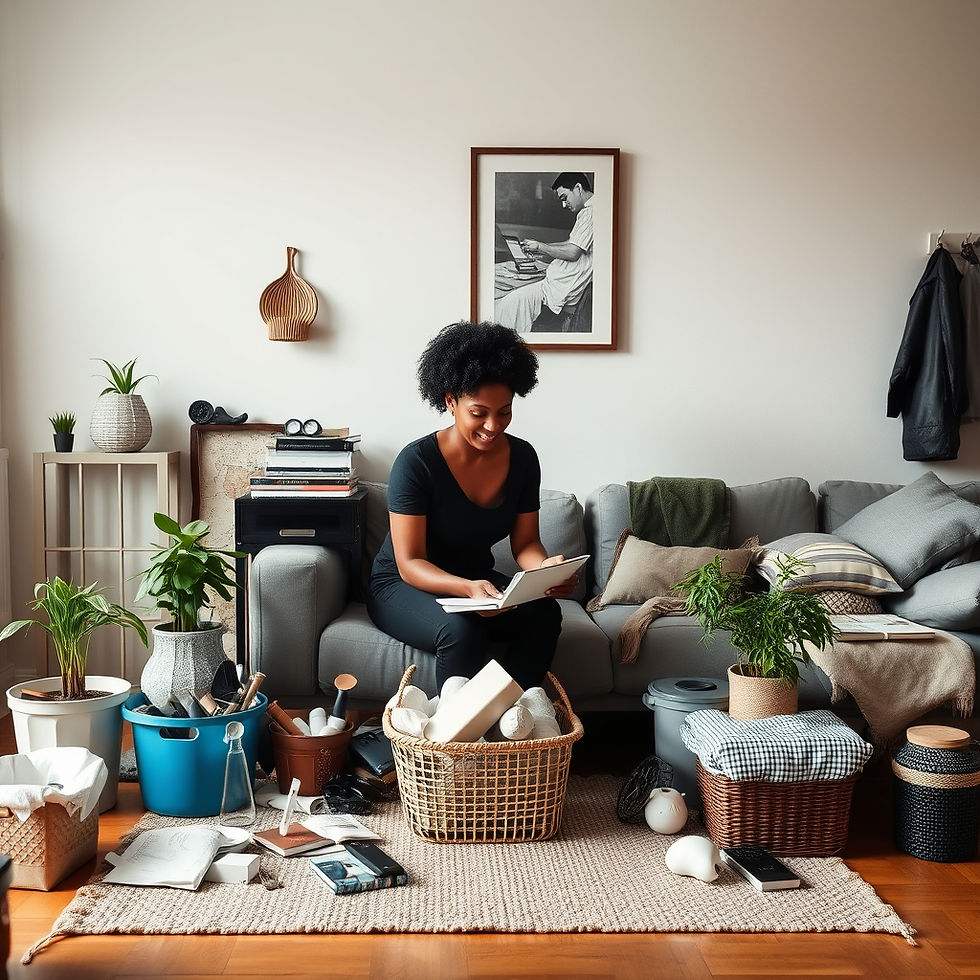
My Gawwwwd, I’m such a hypocrite! How can I write an article about de-cluttering when I’ve got closets full of stuff I know I should let go of? I mean, I love everything I have, but some of it is dated, and some of it holds sentimental value I can’t seem to part with. From shoes and clothes to photos and old toys from the boys, every item feels like it carries a story. For me, I’ll start out strong, ready to toss things into bags, and then poof—I’m on the couch, flipping through pictures of my eldest at three and remembering moments I swore I’d never forget. The thing is there are two things that are true, moments come and go and memories are stored in everyday items. The other is that decluttering is necessary. It’s the only way to make space for new things—in my hands, in my house, and in my heart.
Is that Even Clutter? It's My Stuff.
Clutter is sneaky. It’s not just piles of shoes by the door or mail stacked on the counter; it’s the mental fog that follows you around all day. You walk past it and think, I’ll get to that later, but later never comes. You move things in places that are more visibly annoying to you , and it begins to work and then what? Instead, it nags at you, draining your energy before you’ve even done anything. And in small Brooklyn apartments or good sized homes, where every inch of space counts, clutter can feel like it’s closing in on you. Every time I say, I’ll get to it later, I end up adding to the same pile I promised myself I’d shrink. I keep things for the 'just in case' moment, even if that moment never comes. A shirt too big, (cause I say, 'What if I gain weight', a blender I don’t need but because I'm hooked on Tik Tok recipes I keep it, and a toy that hasn’t been touched since my youngest was 5 because the thought is, I'll keep it for my grandchild. The truth is, those 'just in case' items are just stealing my space and peace of mind.
The truth is, decluttering your home isn’t about becoming a minimalist—it’s about making the space you already have work for you. And in Brooklyn, where closets are basically the size of coat hooks and storage space usually means shoving things under the bed, every item matters. I’ve learned that if I don’t intentionally make room, the clutter will gladly take it for me. So here’s the thing: you don’t have to tackle your whole home in one dramatic purge. Start small: one drawer, one bag, one corner at a time. Donating gently used clothes or dropping off old toys at a seasonal (inserts shameless plug) Brooklyn WATE Open Closet event isn’t just good for your space; it’s good for your health. Plus, it helps someone else in need, which makes it a double win. And hey, regifting (unused) items you’ve held onto out of guilt is perfectly fine.

What We Need To Understand
Physical clutter is one thing, but the hardest clutter to clear is the kind no one else sees—the emotional and mental kind. I’m talking about the grudges we hold, the regrets we replay, the overcommitments we say yes to when we should’ve said no. That’s the clutter that keeps you up at night, even if your closet is finally organized. For me, mental clutter shows up when my to-do list feels endless or when I’m carrying conversations in my head that I never actually had in real life. Journaling, therapy, or just sitting in quiet reflection helps me reset—but so does decluttering my space. It’s all connected. When my room is lighter, so is my mind.
When you’ve got physical clutter piling up, your mind usually resembles the same chaos. The laundry chair that is now a laundry throne, the stuffed closet that barely closes, the kitchen counter that has collected every funky gadget in the social media market; it all echoes upstairs in your thoughts. Reducing clutter in your space doesn’t just free up a room; it frees up a little mental space too. thing Exactly what some of us need, well what I need. (I keep telling y'all this writing is therapy for me too!) A win in decluttering isn’t just about cleaner corners; it’s a reminder that we’re capable of creating order, of quieting self-doubt, and of building a little more peace into our lives.
The Just In Case Pile
(my favorite pile, bad decision, though)
“Just in Case” sounds practical, but if we’re honest, it usually translates to something deeper: just in case I gain weight, just in case I regret letting it go, just in case I need proof of who I used to be. Thats when our feelings get hurt and we have to sit in our own thoughts and wonder. Sometimes we’re not holding onto the object, we’re holding onto an identity, an expired version of ourselves or our life, possibility, or fear. But if you haven’t worn it in a year, if it doesn’t reflect your life today, if it takes up more mental space than practical space, it might be time to say "be gone!" Letting it go doesn’t make you ungrateful or dismssive of a past with said item in it, it means you’re evolving. Keeping two crock pots because you feel bad tossing one, because Aunt Rachel bought it only gives you more of a reason to keep the two coffee pots and 2 toasters you have in the closets too. That’s clutter with a side of guilt. Regifting unused items or at least passing them down to a younger family member who might be moving into the dorms or getting their own apartment might alleviate that misdirected guilt.
When Your Space Is Loud, You Mind Is Loud Too.
When your physical space is cluttered, your mind often mirrors it. Research from UCLA’s Center on Everyday Lives of Families found that women living in cluttered environments had higher cortisol levels which means their stress hormones were elevated simply from being in their space. You might thing that is dramatic but its actually not dramatic. It's totally biological. Environmental psychology studies also show that excessive visual clutter increases cognitive load this in addition to the mental load of day to day procssing. So basically your brain has to work harder to process everything it sees in addition to the day to day management of Life as its Life'n. That can impact focus, mood, and even decision-making. So when we feel overwhelmed in a cluttered room, we're not weak, Our nervous systems are responding. Clearing space isn’t just aesthetic. It’s a way to preserve our mental hygiene.
The Practical Reset ( clearly the one I can do. )
You do not need to flip your entire house in one weekend like you’re starring in a home makeover special. I've tried that, it doesnt work, trust me. Start small. Really small. Pick one thing and commit to it:
• One drawer
• One shelf
• One bag
• 15-minute timer
That’s it. Decluttering works best when it becomes rhythm, not punishment. When you complete small organizing tasks, your brain actually releases dopamine. Dopamine is the reward chemical that says, “See? You did something and it feels good.” Those tiny wins build momentum, and momentum regulates that overwhelming feeling. It shifts you from chaos to control and makes you feel lik you can accomplish anything versus the exhausting feeling of abandoment or failure. And here’s where the mental health meets the practical: donating gently used or new clothing to the seasonal Brooklyn WATE Open Closet is super good for your nervous system too ( yep another shameless plug) . Research in positive psychology shows that giving to others increases overall well-being and reduces stress. Releasing helps you. Receiving helps someone else. That is a WIN-WIN situation happening. We Got This Ladies.. We really do.
Finally.....
The Hardest Clutter: The Heart (IYKYK)
(Y'all knew this was coming)
The heaviest mess is not in your closet. It is not under your bed. It is not in that overstuffed hallway drawer full of knickknacks around the house. It is in your heart. It is all the old resentment you swear you are over but still feel in your chest. When something reminds you of a blip of time in your past, it triggers the scent, the music, the flashes of images that bring you all the way back. It is all the unspoken disappointment and failures. It is overcommitment because you do not want to let anyone down.

It is the conversation you replay in the shower where you finally say the thing you wish you had said to a girlfriend, in an argument, to a significant other. Its the self doubt you keep entertaining that plants roots in your thoughts. That kind of clutter is not only sneak but can be debilitating. Psychological works in academia on rumination shows that when we repeatedly dwell on unresolved emotional stress, it increases anxiety and depressive symptoms. So what does that mean? It means that when we keep looping the same hurt or frustration in our minds, our nervous system does not get the memo that we are safe. It stays activated. It stays tired. It stays in a mode to hide or to survive. Which means the climate it creates requires that you will work harder to thrive.
Decluttering your heart does not look like a dramatic speech or a big social media announcement. It looks like setting a boundary and sticking to it. It looks like forgiving yourself for the mistakes you made three years ago or when you were a teenager/adolescent. It looks like saying NO without a five paragraph explanation. It looks like releasing people, expectations, and narratives that do not pour back into you OR just choosing a path that might solely serve you.
It is quiet work. But it is powerful work.
And sometimes clearing your heart gives you more space than clearing any closet ever could. So lets take a moment and adopt the The 21-Day Space Shift
Here’s OUR challenge.
Pick one area:
a) Hands — what you’re physically holding onto
b) House — your environment
c) Heart — emotional weight
Commit to 21 days of small, consistent release.
Behavioral research shows that habit formation is built through repetition, not intensity.
You don’t need a dramatic purge.
You need consistency.
One bag out. One boundary set. One thought reframed.
That’s how space is created.
Why This Matters
Decluttering is not about becoming minimal.It’s about becoming intentional. Sometimes being intentional requires just a bit more "front-loaded" effort. It means put in the work in the beginning so the machine works well on its own. Easier said than done, I suppose but probably well worth the effort.
The world that we live in constantly demands more from us, as women, especially as Black women. It requies us to be at the top of our game in addition to being more productive in corporate and educational spaces, out perform others to show that we belong and are deserving, more proof to gain our earned access and equity. Creating space is a radical act of self-regulation. We cannot welcome new blessings with our hands, house, and heart full.
Make room.
Breathe easier.
We deserve space — physically and mentally.
Finally I believe we believe wellness isn’t always grand. Sometimes it’s merely therapy. Sometimes it’s prayer. Sometimes it’s a hard conversation to get through. And sometimes it’s just a matter of cleaning out a drawer.
Sometimes healing starts with space.
And I'm right here in the trenches with you.
References
Dunn, E. W., Aknin, L. B., & Norton, M. I. (2008). Spending money on others promotes happiness. Science, 319(5870), 1687–1688.
Nolen-Hoeksema, S., Wisco, B. E., & Lyubomirsky, S. (2008). Rethinking rumination. Perspectives on Psychological Science, 3(5), 400–424.
Saxbe, D. E., & Repetti, R. L. (2010). No place like home: Home tours correlate with daily patterns of mood and cortisol. Personality and Social Psychology Bulletin, 36(1), 71–81.
Vohs, K. D., Redden, J. P., & Rahinel, R. (2013). Physical order produces healthy choices, generosity, and conventionality, whereas disorder produces creativity. Psychological Science, 24(9), 1860–1867.
Wood, W., & Neal, D. T. (2007). A new look at habits and the habit-goal interface. Psychological Review, 114(4), 843–863.
Watkins, E. R. (2008). Constructive and unconstructive repetitive thought. Psychological Bulletin, 134(2), 163–206.
Roster, C. A., Ferrari, J. R., & Jurkat, M. P. (2016). The dark side of home: Assessing possession “clutter” on subjective well-being. Journal of Environmental Psychology, 46, 32–41.

Malene Brissett is a wife, mother, and advocate for equity who writes as her own form of therapy. She holds a Master’s degree in Public Health and a Bachelor of Science in Psychology, blending research with storytelling to spark conversations that matter. She prides herself on being with the women, for the women—bringing equity and understanding to underserved communities.


Comments